XH3004 Physical Assessment Across the Lifespan: Cultural Competence and Abnormal Findings – Sample Presentation
Published 2026-08-19
XH3004 Assessment Instructions Summary
The XH3004 Performance Task is structured as a PowerPoint presentation that integrates cultural competence with physical assessment across the lifespan. The rubric divides the work into two major modules. In the first section, the learner explains what cultural competence means in professional nursing practice and describes how culturally competent care can improve communication, trust, patient experience, adherence, equity, and health outcomes. The learner also explains practical approaches for demonstrating cultural competence and cultural humility, including ongoing self-reflection and individualized care rather than stereotyping. A key requirement is to analyze why knowledge of a patient’s cultural norms, values, beliefs, language, and preferences matters during a physical assessment. The presentation should then introduce a focus patient by clearly identifying age, cultural background, health background, and the purpose of the physical examination.
The second section addresses an abnormal physical-assessment finding. The learner explains what was found, how the abnormality was identified, and why it differs from expected findings. The finding must also be interpreted in relation to the patient’s age and place in the lifespan. The presentation should show how cultural knowledge affects the way the nurse explains the finding to the patient, then describe decision making about next steps and the factors that would be considered if a referral were required. Finally, the learner reflects on the impact and value of the experience for nursing practice using specific examples. The rubric also evaluates professional presentation quality, organization, tone, visual clarity, originality, credible evidence, attribution, and APA-style citations and references. To reach the strongest performance level, responses should be accurate, thorough, logically organized, and supported with appropriate evidence.
Completed XH3004 Presentation
Slide 1
Culturally Competent Care & Responding to Abnormal Physical Findings
RN-BSN Tempo Program, Walden University
Health Assessment
XH3004: Physical Assessment Across the Lifespan
Month 05, 2025
Slide 2
What is Cultural Competence in Nursing?
Definition: Ability to provide care that respects diverse beliefs, values, and practices (Antón-Solanas et al., 2022).
Combines awareness, knowledge, and skills to reduce disparities.
Includes cultural humility ongoing self-reflection and learning (Brown et al., 2021).
Aims to improve trust, communication, and health equity.
Nurses need to reflect on themselves and their education in order not to fall into stereotypes.
Slide 3
Benefits of Culturally Competent Care
Improves patient-provider communication and trust (Khalaf et al., 2025).
Reduces health disparities among minority groups (Lau & Rodgers, 2021).
Increases adherence to treatment plans (Farsangi et al., 2023).
Enhances patient satisfaction and outcomes (Gradellini et al., 2021).
Slide 4
Practical Approaches to Demonstrating Cultural Competence
Cultural humility > "competence": Lifelong learning vs. mastery (Brown et al., 2021).
Use trained interpreters (never family) for language barriers.
Ask open-ended questions: "What traditions are important in your care?"
Avoid stereotypes: Individualize care (e.g., pain expression varies by culture).
Slide 5
Culture’s Role in Physical Assessment
Modesty norms: Some cultures prohibit exposure or opposite-gender examiners.
Touch taboos: Certain religions restrict physical contact.
Communication styles: Indirect vs. direct symptom reporting.
Beliefs about illness: May attribute symptoms to non-medical causes (e.g., spiritual).
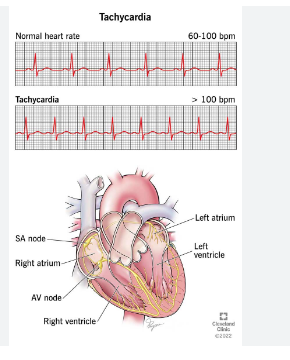
Marked deviation from baseline HR (~80 bpm, regular rhythm)
Tachycardia, demonstrating an abnormal heart rhythm (Cleveland Clinic, 2025)
Slide 8
Abnormal Finding – Atrial Fibrillation (AFib)
Finding: A distinct fourth heart sound (S4) at the cardiac apex.
Why Abnormal: Decreased compliance of the left ventricle that is from hypertensive hypertrophy or ischemic changes and not the normal dual heart sounds (Appunni et al., 2024).
Lifespan Context: Myocardial elasticity begins to decrease with gradual increase in interstitial collagen and fragmentation of elastin fibers (Early adulthood). Progressive loss of cardiomyocytes (midlife). Left ventricular compliance is decreased as myocardial tissue becomes less elastic and more fibrotic (60 + yrs) (Ramos-Marquès et al., 2021).
Slide 9
Decision-Making on Abnormal S4 Gallop
Accentuated S4 gallop in a 65-year-old patient with long-standing hypertension and diabetes with intermittent chest pain, stratified the risk toward ischemic heart disease.
A 12-lead ECG and cardiac enzyme assays to rule out acute ischemia.
A transthoracic echocardiogram to rule out ventricular hypertrophy and diastolic dysfunction (Soh et al., 2024).
Referral to a cardiologist with immediate priority to help decide additional testing methods and treatments.
Slide 10
Sharing the Finding with Cultural Sensitivity
Used hospital interpreter (not family) for precise communication.
Involved family: Daughter present to address patient’s cultural preference for family involvement (Diaz & Nino, 2019).
Recognized essence of faith: offered to get a chaplain and praying with the patient (Catholic Truth Society, 2018).
Avoided jargon: Used empathetic, culturally resonant language i.e. formal ‘usted’ Spanish
Slide 11
Next Steps and Consideration for Referral
Referral: Cardiologist + culturally tailored education on anticoagulants.
Teach back sessions on warfarin (to address his fear of ‘blood thinners’)
Personal Growth: Now routinely screens for health literacy + cultural beliefs.
Institutional Impact: Advocated for interpreter services in EHR.
Slide 12
Impact on Nursing Practice
Develops cultural awareness while prioritizing respectful communication along with cultural humility
Improved trust between caregivers and patients
Better treatment adherence (Khalaf et al., 2025)
Increased ability to create well-rounded referral plans that accommodate patients' cultural circumstances (Pandit et al., 2024)
Slide 13
References
Antón-Solanas, I., Rodríguez-Roca, B., Vanceulebroeck, V., Kömürcü, N., Kalkan, I., Tambo-Lizalde, E., ... & Subirón-Valera, A. B. (2022). Qualified nurses’ perceptions of Cultural competence and experiences of caring for culturally diverse patients: a qualitative study in four European countries. Nursing Reports, 12(2), 348-364.
Appunni, S., Rubens, M., Ramamoorthy, V., Saxena, A., McGranaghan, P., Khosla, A., Doke, M., Chaparro, S., & Jimenez, J. (2024). Molecular remodeling in comorbidities associated with heart failure: a current update. Molecular biology reports, 51(1), 1092. https://doi.org/10.1007/s11033-024-10024-7
Barrett, K. E., & Barman, S. M. (2018). Ganong’s medical physiology examination & board review. Mcgraw-Hill Education.
Brown, J. V., Spicer, K. J., & French, E. (2021). Exploring the inclusion of cultural competence, cultural humility, and diversity concepts as learning objectives or outcomes in healthcare curricula. Journal of Best Practices in Health Professions Diversity, 14(1), 63-81.
Catholic Truth Society, (2018). Caring for the Catholic Patient Meeting the Pastoral Needs of Catholic Patients, Catholics in Healthcare. https://cbcew.org.uk/plain/wp-content/uploads/sites/3/2018/11/CCP_Meeting_the_Pastoral_needs_of_Catholic_Patients.pdf
Cleveland Clinic. (2025, January 31). Tachycardia (High Heart Rate): Symptoms & Treatment. Retrieved April 25, 2025, from https://my.clevelandclinic.org/health/diseases/22108-tachycardia
Diaz, C. J., & Nino, M. (2019). Familism and the Hispanic Health Advantage: The Role of Immigrant Status, Journal of Health and Social Behavior, 60(3) 274–290.
Farsangi, S. N., Khodabandeh Shahraki, S., Cruz, J. P., & Farokhzadian, J. (2023). Designing, implementing, and evaluating a mobile app-based cultural care training program to improve the cultural capacity and humility of nursing students. BMC Medical Education, 23(1), 979.
Slide 14
References
Gradellini, C., Gómez-Cantarino, S., Dominguez-Isabel, P., Molina-Gallego, B., Mecugni, D., & Ugarte-Gurrutxaga, M. I. (2021). Cultural competence and cultural sensitivity education in university nursing courses. A scoping review. Frontiers in psychology, 12, 682920.
Khalaf, Y., Jasim, M.S., Ahmed, A.A., Yaseen, K., Fathi, & Attia, Y. (2025). Voices from the future: A Qualitative exploration of undergraduate nursing students' perspectives on the nursing profession. Nursing and Health Sciences Journal (NHSJ), 5(1), 113-122.
Lau, L. S., & Rodgers, G. (2021). Cultural competence in refugee service settings: a scoping review. Health equity, 5(1), 124-134.
Pandit, A. U., Tomasino, K. N., Aswani Omprakash, T., & Epstein, D. E. (2024). Cultural considerations in gastroenterology: barriers to care and a call for humility and action. Translational gastroenterology and hepatology, 9, 74. https://doi.org/10.21037/tgh-24-17
Ramos-Marquès, E., García-Mendívil, L., Pérez-Zabalza, M., Santander-Badules, H., Srinivasan, S., Oliveros, J. C., Torres-Pérez, R., Cebollada, A., Vallejo-Gil, J. M., Fresneda-Roldán, P. C., Fañanás-Mastral, J., Vázquez-Sancho, M., Matamala-Adell, M., Sorribas-Berjón, J. F., Bellido-Morales, J. A., Mancebón-Sierra, F. J., Vaca-Núñez, A. S., Ballester-Cuenca, C., Jiménez-Navarro, M., Villaescusa, J. M., … Pueyo, E. (2021). Chronological and biological aging of the human left ventricular myocardium: Analysis of microRNAs contribution. Aging cell, 20(7), e13383. https://doi.org/10.1111/acel.13383
Soh, C. H., de Sá, A. G. C., Potter, E., Halabi, A., Ascher, D. B., & Marwick, T. H. (2024). Use of the energy waveform electrocardiogram to detect subclinical left ventricular dysfunction in patients with type 2 diabetes mellitus. Cardiovascular diabetology, 23(1), 91. https://doi.org/10.1186/s12933-024-02141-1